6 min read · September 16, 2026
Napoleon crossing the Alps: the painting, the myth, and the mule
David painted Napoleon on a rearing stallion. He crossed on a mule, in fine weather, several days behind the army, guided by a local. Both facts are true, and the gap between them is the point of the picture.
It is one of the most reproduced political images ever made, and almost every element of it is a deliberate lie. That is not a criticism. Jacques-Louis David knew exactly what he was doing, and the picture is more interesting once you know what he changed.
What the painting shows
Bonaparte franchissant le Grand-Saint-Bernard, painted 1801–05 in five versions. A young general in a windblown cloak on a rearing white stallion, arm raised, pointing up the pass. Wind, cloud, rock. Cut into the stone at his horse’s feet are three names: BONAPARTE, HANNIBAL, KAROLVS MAGNVS — Charlemagne. The message needs no caption.
What happened
In May 1800 the Reserve Army crossed the Great St Bernard Pass into Italy. Napoleon did cross. But:
- He crossed several days after the bulk of the army, once the route was secured.
- He rode a mule, not a horse, led by a local guide named Pierre Nicolas Dorsaz, because a mule is what you use on that ground.
- The weather was reportedly fine.
- He wore a grey coat, not a billowing crimson cloak.
The commission came from Charles IV of Spain and the brief was explicit. Napoleon is said to have told David he wanted to be shown calme sur un cheval fougueux — calm on a fiery horse. He also declined to sit for it; David worked from a uniform, a hat, and his son posed on a ladder.
Paul Delaroche painted the sober version half a century later, in 1848–50: Napoleon slumped on a mule, a guide on foot, grey light. It is a much better picture of a man crossing a mountain and nobody has ever put it on a poster.
The coronation is the same trick, at four times the size
David’s other enormous Napoleonic canvas, Le Sacre de Napoléon (1805–07), is over six metres by nine and hangs in the Louvre. It shows Napoleon crowning Joséphine in Notre-Dame.
The edits:
- Napoleon’s mother is in the picture. Letizia Bonaparte refused to attend. David put her in the central box because the composition needed a matriarch.
- The Pope is blessing the act. Pius VII was reportedly painted sitting with his hands in his lap, and Napoleon had David change it to a blessing.
- The original composition had Napoleon crowning himself, arm raised. David reworked it so he is crowning Joséphine instead — less arrogant, and a better line.
A painting this size, altered this much, produced within two years of the event, is not a record. It is a press release executed to the highest standard available in 1807.
Why we do not sell them
We get asked. The answer is straightforward: these are paintings held in national collections, and the usable high-resolution photographs of them belong to those museums. We print from public-domain archive scans that we are certain we may print, and we say which archive on every product page. A museum’s photograph of a French state painting does not meet that test.
There is also a more honest reason. Someone searching for Napoleon crossing the Alps is nearly always after the image itself, and the right place to look at it is the Château de Versailles collection online, free, at high resolution. Selling you a print of a photograph we do not own would serve us and not you.
What is genuinely from the period and printable
The French state produced an extraordinary amount of printed material in these decades, and printed material is where the public domain lives. City plans, military survey sheets, engraved views — all published, all long out of copyright, much of it digitised beautifully.
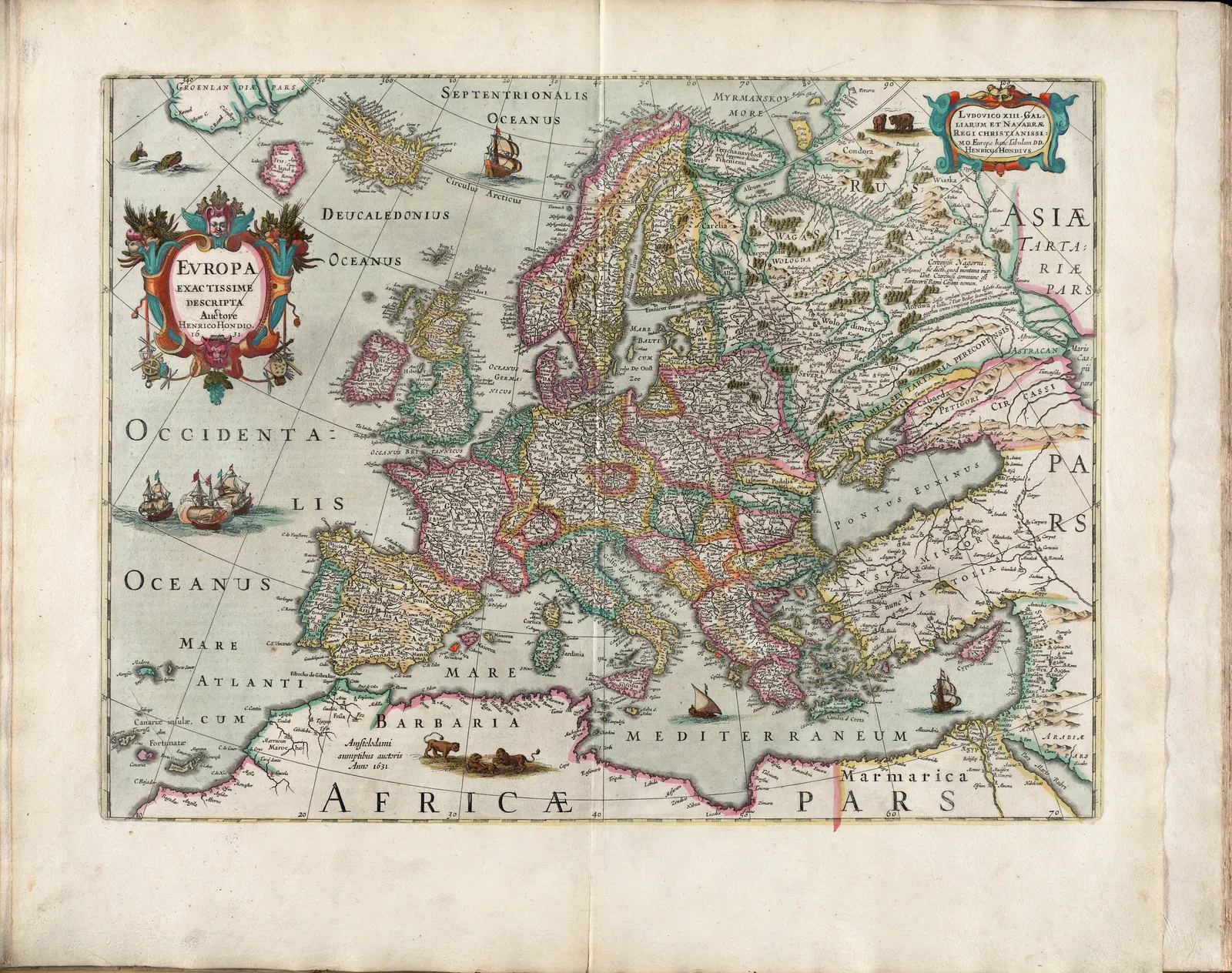
Our Hondius map of Europe predates Napoleon by a century and a half and shows the continent as a set of pieces — the Italian states, the German principalities, the Alpine passes between them — rather than the shape he would spend fifteen years trying to force it into. If you want the Napoleonic era itself as a print, the custom request form is the route — engraved views and campaign maps from the 1800s exist in quantity and we can usually find a specific one within a few days.
Sources
Where this came from
- Château de Versailles — Bonaparte franchissant le Grand-Saint-Bernard
- The Louvre — Le Sacre de Napoléon
- Library of Congress — Napoleonic era prints and maps
Corrections are welcome and we publish them — info@antiquemapprints.com. Nothing here is generated from a template; if something is wrong it is our mistake, not a machine's.
