6 min read · September 16, 2026
The WPA poster programme: 1,400 designs, about 900 survivors
Between 1936 and 1943 a federal work-relief programme put unemployed artists to work silkscreening posters. Around 2,000 of the original impressions are known to survive, most of them in one building in Washington.
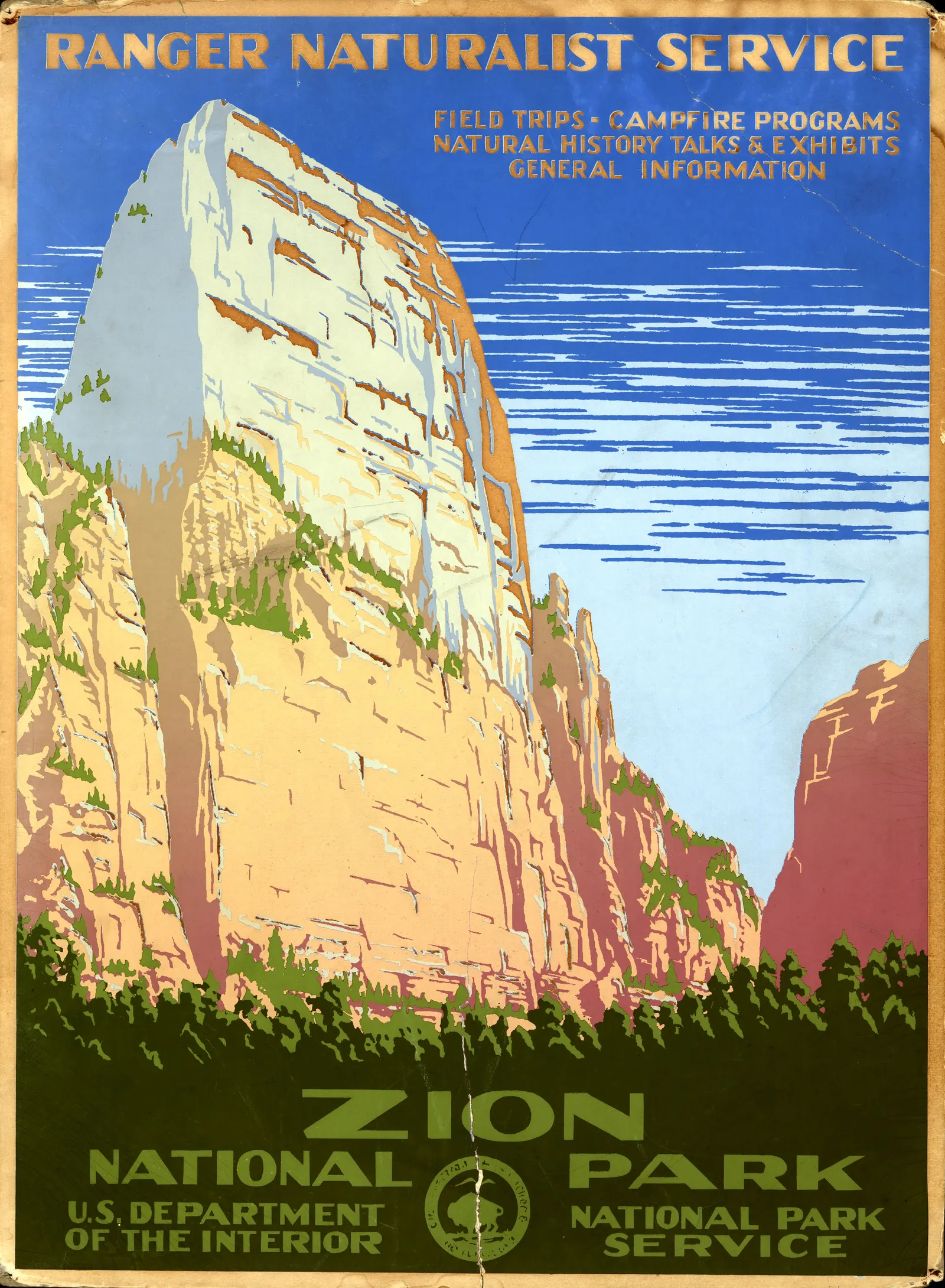
The flat-colour national park posters you see everywhere now — Zion in green and ochre, Grand Canyon in layered red — are not a modern design style. They are a specific body of work made by specific people for a wage, in a specific eight-year window, and most of it is lost.
What the programme was
The Works Progress Administration was created in 1935 to put unemployed Americans to work. Federal Project Number One covered the arts, and within it the Federal Art Project employed painters, illustrators and printers. One strand of that work was posters: for public health campaigns, adult education, the theatre, travel, safety, and the national parks.
They were made by silkscreen — a stencil process where ink is pushed through a fine mesh, one screen per colour. It suited the moment perfectly. It was cheap, it needed no press, a small team could produce a few hundred impressions in a day, and it rewards exactly the flat, bold, few-colour design the posters are famous for. The aesthetic is a consequence of the method and the budget.
The Library of Congress estimates about 2,000 posters survive of an output of roughly 35,000 impressions from some 2,000 designs, with around 900 designs represented. The Library holds the largest collection by a wide margin. That survival rate is not unusual for ephemera: these were pasted up in railway stations, post offices and ranger stations, and then thrown away.
The park posters specifically
Only a handful of national parks ever got one. That is worth knowing before you go looking for your favourite park: if there is no original WPA sheet for it, nobody can sell you one, and anything offered is a modern illustration in the style. Grand Canyon, Zion, Yellowstone, Lassen Volcanic, Great Smoky Mountains, Petrified Forest, Fort Marion, Wind Cave, Glacier, Grand Teton and a few others are the surviving set, alongside the broader See America and The National Parks Preserve Wild Life series.
The posters were not really advertisements. They were produced for the National Park Service partly to promote the Ranger Naturalist Service — the guided walks, campfire talks and exhibits — which is why several of them carry that phrase in the top band rather than the park’s name.
Why they are in the public domain
They were produced by a federal work-relief programme, and works of the United States government are not subject to copyright in the US. That is why you see them reproduced so freely, and it is why we can print them and say exactly where the scan came from.
It also means the field is full of two very different things sold under one name:
- Restored prints of the actual surviving sheets — what we sell. The fold lines, the foxing and the scanner cast are removed by hand; the paper tone, the screen registration and the original ink are left exactly as the surviving impression has them.
- Modern illustrations in WPA style — often very good, often by identifiable living artists and studios, and in copyright. Some of the best-known park poster series sold today are contemporary work, not 1930s work, and their creators are entitled to that credit.
Neither is dishonest as long as it is labelled. The problem is the third category: a modern illustration sold as a “vintage WPA poster”. If a seller cannot tell you which archive holds the sheet and what year it was printed, they do not know.
What a good reproduction has to get right
Flat colour is unforgiving in a way that photographs are not.
A silkscreen is large areas of a single ink meeting at a hard edge. Enlarge a small JPEG of one and two things happen immediately: the flat fields band into visible steps, and the lettering edges go ragged, because there is no fine detail for the upscaler to work with — only edges, and edges are what it destroys. This is why a cheap WPA reproduction looks worse than a cheap photograph reproduction of the same size.
Starting from the archive master is the only fix. Ours come from the Library of Congress’s own scans, restored by hand and printed at 200 dpi or better at every size we sell, which is what lets a 24-inch print hold its edges.
They are tall for a reason, and it is useful
The sheets are narrow and vertical because they were designed to be pasted in a station or on a noticeboard. That proportion is awkward for most wall art and perfect for three places most houses have: a stairwell, a hallway, and the gap either side of a doorway. Hung as a row of three or four in matching frames they read as one piece, because the series shares a palette and a format.
Our eleven sheets are on the national park posters page, and the gallery wall builder will show you a group of them to scale on a wall before you commit to a size.
Sources
Where this came from
- Library of Congress — WPA Poster Collection
- Library of Congress — About the WPA Poster Collection
- National Park Service — history of the WPA park posters
Corrections are welcome and we publish them — info@antiquemapprints.com. Nothing here is generated from a template; if something is wrong it is our mistake, not a machine's.


