7 min read · September 16, 2026
What the Description de l'Égypte actually recorded
Napoleon took 167 scholars to Egypt in 1798 and lost the war. The 23 volumes they published anyway remain the most detailed record of a country that was about to be picked apart — and the reason most 'Egyptian art' you have seen is French engraving.
If you have a mental image of ancient Egypt — the Sphinx half-buried to the neck, the zodiac ceiling at Dendera, a hypostyle hall of columns receding into dark — there is a good chance you are picturing a French engraving from the 1820s rather than a photograph.
A scientific expedition attached to an invasion
Napoleon Bonaparte sailed for Egypt in 1798 with an army and, unusually, with a Commission des Sciences et des Arts: some 167 mathematicians, astronomers, engineers, botanists, zoologists, surveyors, architects and draughtsmen. The military campaign went badly and ended in French withdrawal in 1801. The scholarly one did not stop.
Between 1809 and 1829 the French state published the results as the Description de l’Égypte: 23 volumes, of which nine are nothing but plates. Over 3,000 engravings. It was produced at enormous expense in a format so large that a purpose-built cabinet was designed to hold it.
The Rosetta Stone was found by French soldiers near Rashid in 1799, recorded by the Commission, and then surrendered to the British under the Capitulation of Alexandria in 1801 — which is why it sits in London today while the French drawings of it sit in the Description. Jean-François Champollion, working partly from those published copies, announced his decipherment of the hieroglyphs in 1822.
Why the plates still matter
Two reasons, and the second is the uncomfortable one.
They are measured, not sketched. These were surveyors and architects. Temples are given in elevation, plan and section, with scales. Reliefs are copied line for line. When a modern Egyptologist wants to know what a wall looked like before a particular collapse, the Description is sometimes the only record.
Much of what they drew is damaged or gone. The nineteenth century was catastrophic for Egyptian monuments — quarried for stone, dismantled for museums, flooded, and in one famous case removed outright. The Dendera zodiac the Commission drew in place on a temple ceiling was cut out with saws and gunpowder in 1820 and is now in the Louvre. The plates are a photograph of a country immediately before it was picked apart.
What “Egyptian art” usually means online
Search for Egyptian art and you will get three different things tangled together:
- Ancient Egyptian work itself — tomb painting, relief, statuary, papyri. Almost all of it is in museums, and photographs of it are usually owned by those museums.
- Nineteenth-century European records of it — the Description, Ippolito Rosellini’s Monumenti dell’Egitto e della Nubia (1832–44), and Karl Richard Lepsius’s monumental Denkmäler aus Aegypten und Aethiopien (1849–59). These are the images that formed the popular visual idea of Egypt.
- Modern decorative work in an Egyptian style, which is neither.
The distinction matters if you want a print. A photograph of a tomb wall is generally somebody’s copyrighted photograph. A plate from the Description, published between 1809 and 1829, is long out of copyright, has been digitised at very high resolution by several institutions, and can be printed honestly by anyone — which is why the serious Egyptian prints you find tend to be engravings rather than photographs.
How to read one
Three habits make these plates much more interesting to look at.
Find the human figure. The draughtsmen almost always put one in — a soldier, a scholar with a notebook, a local guide. It is there for scale, and it tells you instantly how large the thing is. The figures also date the image: the hats are Napoleonic.
Look for the sand line. Many monuments are drawn buried to a specific depth. That line is data: it records how much had accumulated by 1799, before the clearances.
Read the register bands. Egyptian wall decoration runs in horizontal bands, each a separate scene, read in the direction the figures face. The plates copy that structure faithfully, so a single sheet often contains six or seven distinct scenes stacked vertically — which is also why they work so well as tall prints.
What we have, and what we do not
We do not currently sell a Description de l’Égypte plate. We are honest about that rather than listing something adjacent and hoping: our Egyptian line is being sourced now, from the Description, Rosellini and Lepsius, all three of which are public domain and digitised at printable resolution.
If you want a specific plate — a particular temple, the zodiac, a named relief — the custom request form is the fastest route. Sourcing a sheet from these volumes takes a few days, and if the available scan is too small to print at the size you want we will tell you that rather than sell you a soft one.
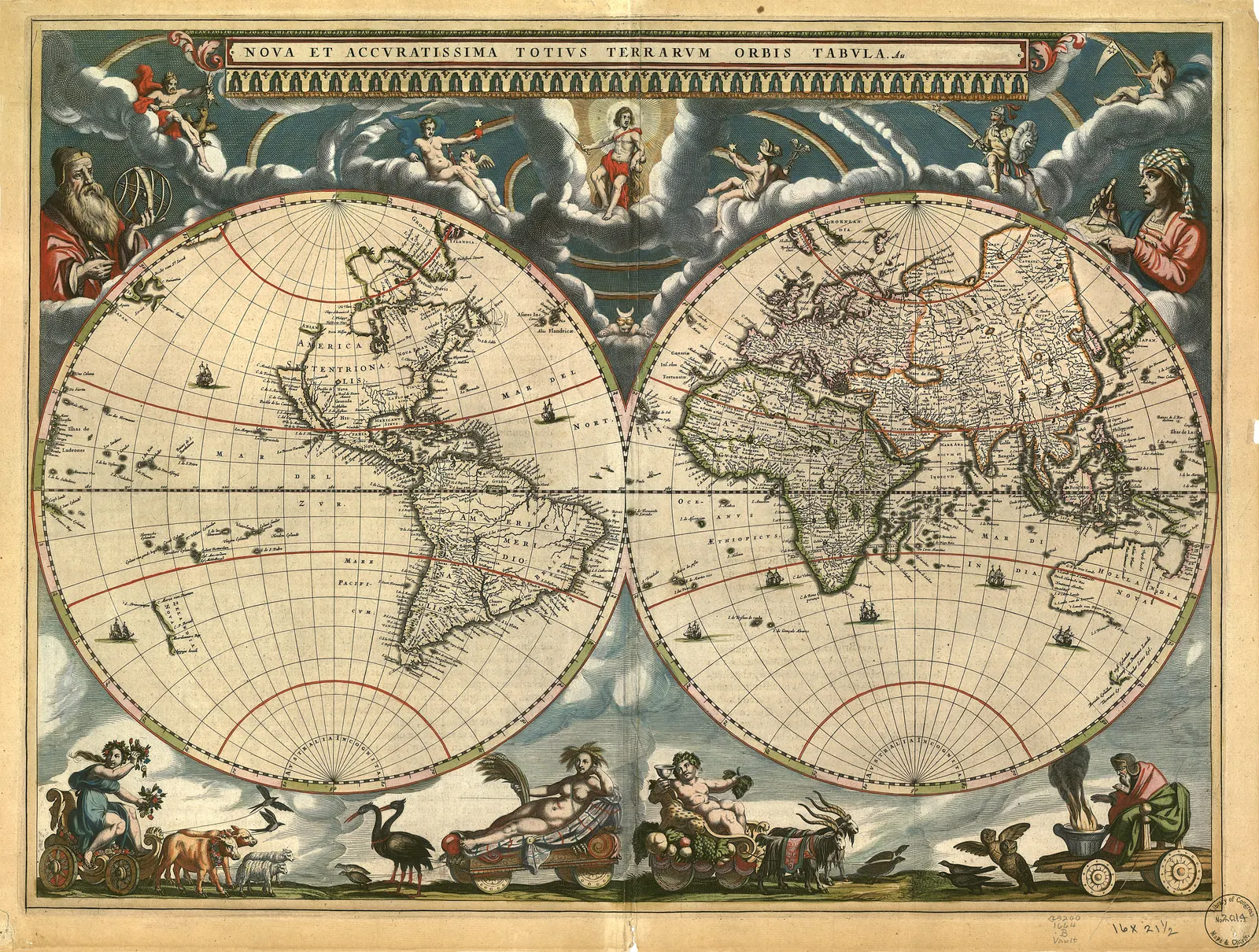
In the meantime, the world maps include several that show Egypt as European cartographers understood it before the expedition — which is its own kind of document.
Sources
Where this came from
- Library of Congress — Description de l'Égypte
- The New York Public Library Digital Collections — Description de l'Égypte
- The British Museum — the Rosetta Stone
Corrections are welcome and we publish them — info@antiquemapprints.com. Nothing here is generated from a template; if something is wrong it is our mistake, not a machine's.
